
Psychological Safety: Why Feeling Safe Is Not The Same As Feeling Permitted To Speak

The organisation has done many of the right things. The Freedom to Speak Up guardian is visible and accessible. Staff survey scores on feeling safe to raise concerns have been improving year on year. Leaders talk about learning, civility and openness. Formal routes exist and are well-publicised. On paper, the culture looks like it is heading in the right direction.
And then a moment arrives where it matters. A concern sits with someone who is close to the risk. The room is under pressure. Senior people are present. The pace is fast. The concern, though real and worth raising, stays soft or travels sideways rather than landing where it needs to.
The question worth asking is not whether the organisation has created a psychologically safe culture in general. It is whether the person closest to the concern, in that specific room, in that specific moment, felt permitted to speak.
Safety as a condition, not a permission
Amy Edmondson, whose research on psychological safety has shaped a generation of thinking on team effectiveness, defines it as a shared belief that a team is safe for interpersonal risk-taking. That is the right foundation. Speaking up involves real interpersonal risk: challenging a more senior person, raising something incomplete or uncertain, saying something that might be wrong in front of people whose opinion matters.
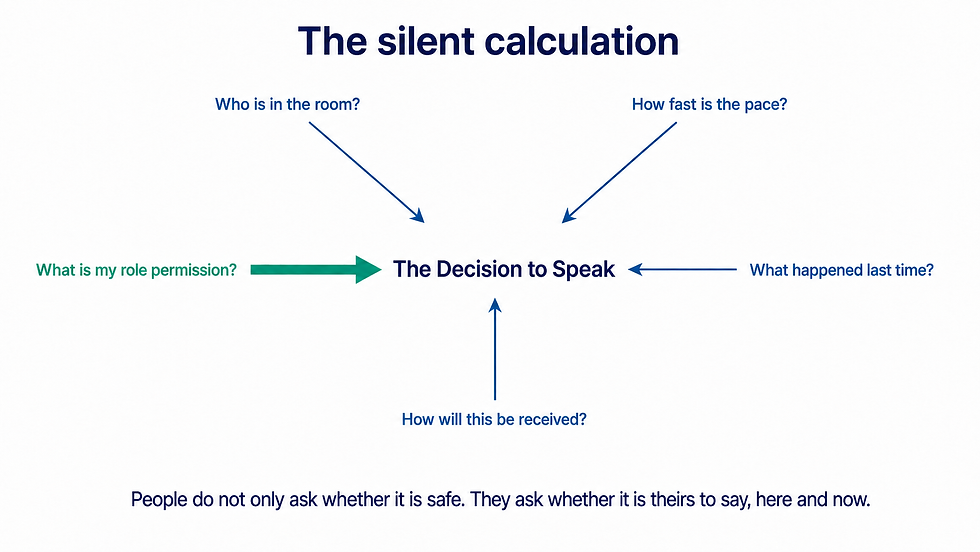
But safety as a shared climate does not automatically travel into every moment of every conversation. People do not make one stable assessment of whether their organisation is safe and then act on it consistently. They make a faster, more local calculation: is this safe to say now, in this room, to these people, in this way? Does this concern feel like mine to raise? Will it be received as useful or as disloyal?
What feels speakable is not fixed. Teams teach people, often without intending to, which concerns count as legitimate and which roles are expected to raise them. This happens not through policy statements but through micro-responses: the tone in which a challenge is received, whether a raised concern is followed up or quietly disappears, whether the person who spoke up in last month's meeting found the experience worth repeating.
One dismissive response can undo a dozen invitations, because people learn from micro-reactions faster than from values statements.
A psychologically safe culture helps, but it does not automatically travel into the most loaded five minutes of a ward round or an executive meeting.
What the research shows
Research on speaking up in healthcare is particularly instructive because the stakes are clear and the hierarchy is steep. Studies by Schwappach, Gehring and others have shown that people deciding whether to speak weigh several things simultaneously: how serious they believe the risk to be, how confident they are in their own reading of the situation, who else is present, what they expect the response to be, and whether they see the concern as legitimately theirs to raise.
The quiet after a question is not always agreement. Sometimes it is people checking the hierarchy before they decide whether to speak.
That last point matters most. In influential work on organisational silence, Dixon-Woods and colleagues identified the idea of a "voiceable concern": before someone speaks, they make a prior judgment about whether this concern is speakable, and whether it is speakable by them. Silence is not always fear. Sometimes it is genuine uncertainty about role, entitlement, timing or whether the room will recognise the concern as valid.
This is where psychological safety, on its own, runs out. A broadly safe culture improves the conditions for voice. It does not automatically resolve, in the moment, the question of whether this person, with this knowledge, at this point in the conversation, is permitted to interrupt.
A moment on an acute ward
The person closest to the risk may also be the person least certain they have permission to interrupt.
A teaching hospital has invested seriously in its speak-up infrastructure. The Freedom to Speak Up guardian is active. Safety huddles run daily. Leaders have been consistent in their messaging about openness and learning. The staff survey results are encouraging.
Then winter pressure hits. On a fast morning board round, the team is working to free beds before midday. A Band 6 nurse is uneasy about the plan to transfer a frail patient to a step-down bed. The observations look stable, but the patient has been more confused that morning and urine output is down. Something does not feel right.
The consultant is moving at pace. The divisional manager is present. A registrar challenged a discharge plan the previous week and was told, in front of others, to take operational concerns offline.
The nurse does not stay entirely silent. She asks a soft question: should they perhaps "just keep an eye on things." The concern lands as hesitancy rather than as challenge. The round moves on. Minutes later, she raises it sideways to the junior doctor, who speaks to the registrar, who asks for a review.
Nothing catastrophic happens. But the pattern is telling. The issue was not whether the trust had a guardian, a survey score or a poster. In that five minutes, voice was shaped by pace, hierarchy, audience, role boundaries and what the team had learned from a previous response about what kind of challenge was welcome. That is where silence still lives, even in organisations that are genuinely trying.
Four moves that make voice more likely in the moment
Design the invitation
"Any concerns?" is often too weak. The question is open enough to allow silence without awkwardness, and vague enough to leave people uncertain whether their concern qualifies. A more deliberate invitation names the kind of input wanted and from whom: "Before we confirm this, I want to hear from nursing, from the most junior clinician in the room, and from anyone who has a different read. What might we be missing?" That specificity lowers the threshold considerably. And when the first person responds, the way that response is received sets the rule for everyone watching.
Use role-based speaking rounds at high-risk points
Hierarchy suppresses spontaneous interruption. When senior confidence is visible and pace is high, people orient towards the senior view rather than risk contradicting it. Structured turns lower the threshold by making contribution expected rather than exceptional. At key decision points, take brief rounds from a fixed sequence: the person closest to the work first, the most senior last. This reverses the usual gravity of the room.
Build pause points into ordinary work
Pace is one of the most reliable thieves of voice. When a conversation is moving quickly toward a conclusion, the moment to interrupt narrows and the cost of doing so rises. Creating a deliberate pause before a significant decision, transfer, discharge or escalation changes the conditions: "Pause here. What are we missing? Who has a different read? What would make this unsafe?" The pause signals that interruption is not only tolerated but expected.
Track whether concerns are visibly closed
People watch what happens after someone speaks. If concerns are welcomed and then quietly disappear, the organisation teaches people that voice is invited in theory and wasted in practice. A simple concern log in regular meetings, noting what was raised, by whom, what happened and whether it was closed, shifts the accountability. The question is not only how many concerns were raised, but how quickly and visibly they were addressed.

The test that matters
Silence is data, not reassurance.
Psychological safety matters. Investing in the conditions for voice is not wasted effort. But the real test is not whether leaders say "please speak up," whether survey scores are improving, or whether formal routes exist. It is whether the person closest to the concern, in the moment that counts, feels permitted to speak here, now, to this room, and whether the room knows how to receive what they offer.
That is where silence is either repeated or changed.
At Common Path Connection, we help leaders look beneath culture scores to the moments where voice is invited, softened or lost.
Our Culture & Ways of Working and Leadership & Teams work helps organisations design the practical speak-up cues, meeting habits and follow-through routines that make challenge easier to offer and harder to waste.
If you would like a structured look at where voice is concentrated and where it is being lost, our Culture Health Check is a useful starting point.
Related reading
Psychological safety matters, but it is not enough on its own. These pieces explore what makes voice, challenge and difficult information usable:
Why Bad News Travels Sideways Before It Travels Upward — why concerns often move around the organisation before they move up.
Culture Changed on Paper. Behaviour Hasn’t. — how the reinforced culture shapes whether people speak honestly.
Why Governance Forums Discuss Everything and Decide Nothing — why voice needs a route into decision, assurance or action.
Comments