
Role Clarity After Restructure: Why The New Boxes Do Not Settle The Work

The organisation chart arrives in inboxes. New titles, cleaner reporting lines, fewer layers. Someone has worked hard on the design. The logic is visible on the page: sharper accountabilities, clearer ownership, a better model for how decisions will flow. For a day or two, people study it carefully.
Then the work resumes. And within weeks, something familiar returns. Decisions bounce between teams. Handoffs are tense. People ask who owns a piece of work that cuts across two or three of the new boxes. A responsibility that looked clear on the chart turns out to have two teams doing it, or none. Someone escalates a call that the new structure implied they should own.
The chart is still on the wall. The work is still blurred.
Why the paperwork is necessary but not sufficient
The instinctive response is to go back to the documents. Rewrite the role descriptions. Sharpen the RACI. Circulate the accountability matrix again with a clearer covering note. These things have value. A poorly written role description genuinely costs more than a well-written one, and responsibility tools can help people orient when ambiguity is genuinely about documentation gaps.
But if the confusion persists after the documents have been tightened, the problem is usually not the paperwork. A structure chart tells people where they sit. It does not tell them, in live work, where they are allowed to move.
Unclear expectations about authority and accountability have a consistent cost: delay, duplication, cautious behaviour and a reluctance to act without explicit sign-off. Organisational routines research, including work by Martha Feldman and Brian Pentland, makes the deeper point: the way work actually happens is not held in documents alone. It is produced in practice, by people acting in specific situations, with the habits, assumptions and informal authority of the previous model still present. A new structure has to be practised into existence. It does not arrive fully formed when the chart is published.
What is still running underneath
A restructure changes reporting lines. It does not automatically change who people trust to make a call, who they defer to in ambiguous situations, which functions carry informal authority, whose challenge is taken seriously, or who is expected to carry the consequences when a borderline judgement proves wrong.
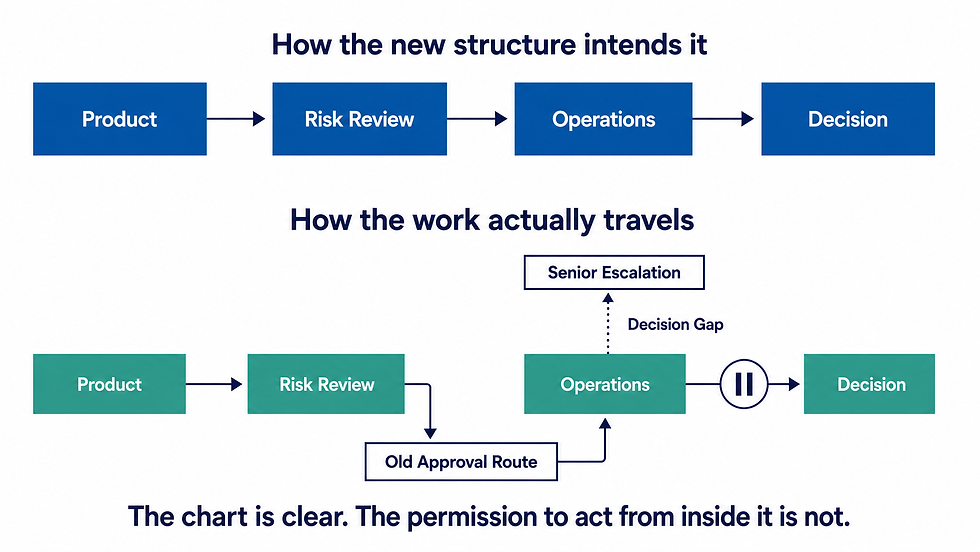
These things shift slowly. Until they do, the formal structure says one thing while the lived system does another. Teams keep using old approval routes because those routes still feel safer, more legitimate, or more consistent with how risk has historically been managed. Decisions still travel to the people who used to own them, regardless of what the new chart says. Meetings fill with people from functions that "need to be in the room," even when the new model intended to narrow that group.
This is not usually resistance in any conscious sense. It is something more like a reasonable response to genuine uncertainty: when the new boundary has not yet been tested, the old one offers more confidence. When authority has not demonstrably moved, people behave as if it has not.
The formal structure may have changed. The lived settlement of authority has not yet moved with it.
A pattern from financial services
A mid-sized UK bank restructures to create clearer end-to-end ownership across Product, Risk, Operations and Customer teams. The design makes sense. Product teams are intended to own more of the customer proposition. Risk is meant to provide oversight and challenge rather than get drawn into day-to-day operational approvals. Operations owns delivery. Customer teams should need to escalate less, because the new model is meant to make trade-offs clearer.
Three months in, the picture is more complicated. Product leaders are still waiting for Risk to approve judgements that Risk believes should now sit firmly in the first line. Risk wants to be involved earlier in product decisions but keeps getting pulled into operational sign-offs because the new boundary is not yet trusted. Operations owns delivery in principle, but hesitates on exceptions because service pace, control requirements and commercial pressure pull in different directions, and it is not yet clear who carries the call when they collide.
Customer teams are still escalating. Not because the escalation route has been left open, but because when customer outcome, compliance interpretation and operational feasibility all point in different directions at once, nobody in the new model has yet found a clear, practised, trusted route to a decision.
In regulated environments especially, this hesitation is often less about resistance than about not wanting to carry accountability without clear authority. The boxes are clear. The permission to act from inside them is not.
A reader in a different sector will likely recognise the same dynamic. The names of the functions change. The pattern does not.
Four moves that help the new structure become real
Map the live handoffs, not just the structure chart
Handoffs are where the new model meets reality. Choose two or three recurring work journeys that already cause delay, tension or escalation, and trace each one from first signal to final decision. Look at where work stops, waits, doubles back or depends on goodwill. At every handoff, ask: who is expected to act? Who can stop the work? Who carries the consequence if the judgement proves wrong? The answers reveal the lived operating model more clearly than any document.
Separate input, recommendation, decision and execution
What looks like role confusion is often decision confusion: too many people who can slow or stop a decision, and not enough clarity about who actually makes it. You do not need a giant enterprise matrix. You need clear decision paths for the choices that matter most, the small number of recurring cross-functional calls, such as risk acceptance, customer exceptions or service-versus-control trade-offs, that keep bouncing. Research on decision rights has long made this point: for high-stakes, cross-functional decisions, clarity at the decision level matters at least as much as clarity at the role level.
Rehearse the new boundary on real cases
Decision rights and role boundaries become credible through practice, not through slides. Bring the relevant function leaders together around a real recent case where the new model was unclear or where the old pattern reasserted itself. Ask: under the new model, who should have framed this? Who should have decided? Who should have challenged? What actually happened, and what would change next time? Use real work that people recognise, not hypothetical edge cases. The gap between the two is often where the live negotiation is.
Watch where senior behaviour quietly reinstates the old model
People infer the real operating model from what senior leaders do, not from what the structure chart says. When a senior leader pulls a decision back upward that the new model intended to sit lower down, the signal is immediate and precise. When a second-line function gets drawn back into approval work the redesign was meant to move elsewhere, it tells the organisation that the new boundary is not yet protected. A review of a month of escalations, asking honestly which were genuinely necessary and which happened because the old pattern still felt safer, is often more revealing than any role clarity exercise.

When the new structure becomes real
After a restructure, the chart is only the beginning. The real work is helping people practise the new boundaries until they become believable, until they trust that authority has moved with accountability, until the new handoff is more reliable than the old approval route.
Ownership becomes clear when people know not only where they sit, but what they are now trusted to decide, challenge, carry and hand on. That does not come from a document. It comes from repetition, from senior behaviour that protects the new boundary, and from enough experience of the new model working that people stop reaching for the old one.
At Common Path Connection, we help leaders look beneath surface role clarity problems to how work, authority and decisions actually move.
Our Organisation Design and Role Clarity & Decision Rights work helps teams turn structure into usable ownership, clear handoffs and decision paths that hold under pressure.
If governance rhythms and cadence are also in scope, our Governance & Cadence Setup work connects directly to this.
Related reading
A restructure only settles the work when authority, hand-offs and decision paths change in practice. These insights continue that thread:
Decision Rights at Work: Why Your Meetings Keep Repeating Themselves — why unclear authority shows up as repeated meetings.
Why Decisions Escalate When Uncertainty Has Nowhere to Go — why people escalate when the risk around a decision is not held clearly.
Why Governance Forums Discuss Everything and Decide Nothing — how unclear forum purpose keeps decisions moving around the system.
Comments